
Custody Documentation Mistakes That Can Hurt Your Case

Custody documentation can strengthen your case when it presents clear facts, consistent records and reliable supporting evidence. Poorly written notes can create the opposite impression, even when your concerns are valid.
A useful co-parenting incident log records dates, events and follow-up actions without turning each entry into an argument. The following mistakes are common, but they’re also preventable.
Emotional Entries Ruin Credibility
Angry labels and personal attacks make documentation less persuasive. An entry such as “My ex was selfish again” gives a judge no useful facts to evaluate. It may also suggest that conflict between the parents is shaping the record.
Describe what happened in terms another person could verify. For example: “The scheduled pickup was 5 p.m. The other parent arrived at 6:10 p.m. and sent a text at 5:45 p.m. stating that traffic caused the delay.” Include the effect on the child only when you observed it directly, such as a missed appointment or an interrupted bedtime.
Write entries after you’ve had time to settle down. If a note contains insults, predictions about motives or sweeping words such as “always” and “never,” revise it before saving.
Maintain an Objective Communication Log
Use one consistent place to record custody-related communication. Your log might be a spreadsheet, a secure parenting app or a dated document stored in a protected account. Record the date, time, communication method, subject and any response that followed.
Keep the wording brief. A useful entry might say: “March 12, 7:20 p.m. Sent a message asking to confirm Friday’s school pickup. Response received March 13 at 8:05 a.m. confirming pickup.” Preserve the original message or email when it supports the entry.
Don’t send repeated messages merely to create a longer paper trail. One clear request and a reasonable follow-up usually show more responsible communication than a string of texts. Your records should reflect genuine attempts to coordinate the child’s schedule, health care and school needs. When disagreements involve missed exchanges or changes to agreed arrangements, understanding what to do when the other parent breaches a parenting agreement can also help clarify the appropriate steps to take.
What Judges Actually Want to See
Family courts generally focus on the child’s welfare and each parent’s ability to provide stable care. Although legal standards differ by state, common best interests factors include the child’s needs, home stability and each parent’s willingness to support a healthy relationship with the other parent.
Documentation should connect directly to those concerns. School attendance reports, medical appointment records and messages about schedule changes may be useful. A folder filled with minor complaints about clothing choices or writing style usually adds noise.
Patterns carry more weight than isolated inconveniences. Three documented missed exchanges in six weeks, supported by messages and timestamps, provide clearer information than a general claim that the other parent is unreliable. Accuracy matters, so correct errors as soon as you notice them and explain any revision.
Vet Evidence With Divorce Attorneys
Ask a legal professional to review your material before you submit, quote or rely on it. Experienced divorce attorneys can explain which records may be relevant, how local rules affect evidence and what information could hurt your position.
Bring organized copies to the meeting. Include your parenting plan, a one-page chronology and the original files behind important entries. Tell your attorney how each item was obtained. Secret recordings, account access and screenshots can raise legal or authenticity concerns depending on the circumstances.
Avoid editing an image in a way that removes context. Save the full conversation as well as any focused screenshot. Your attorney needs to see unfavorable messages too, including your own. Surprises discovered by the other side can damage your credibility more than an imperfect exchange that you disclosed early.
Organize Digital Timelines Cleanly
Build a timeline that lets someone understand the sequence without opening dozens of files. Name each item with the date first, followed by a short description, such as “2026-04-08-school-absence-email.” Use separate folders for school, health care, exchanges and parent communication.
Create an index listing each file, its date and its relevance. Back up the complete folder to a secure location, but preserve original file formats and metadata whenever possible. Printed records should use page numbers that match your index.
Finish with a short chronology containing only significant events. Each line should point to the supporting file instead of retelling the entire dispute. Before sharing anything, check that private details about unrelated people have been removed as advised by your attorney. A clean timeline lets the facts stand on their own and keeps the focus where it belongs: your child’s daily stability.
Image Credit: Unsplash

About the Author
Fred Campos is a father, custody advocate, and host of the Daddy Got Custody podcast. He shares practical parenting and child custody tips to help parents navigate family court with confidence.
Join Our Newsletter

Why Does Child Custody in Texas Matter When One Parent Wants to Relocate?
When one parent wants to relocate, the issue often reaches far beyond a change of address. A move can affect school schedules, weekday parenting time, travel costs, communication patterns, and the child's sense of routine. What looked manageable when both parents...
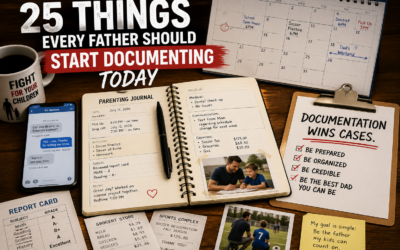
25 Things Every Father Should Start Documenting Today
The Best Memory Doesn't Win in Court One of the biggest mistakes fathers make is assuming they'll remember everything when it's time to testify. You won't. Custody cases often take months—or even years—to resolve. By then, the details blur together. Dates get...

What Judges Look for When Deciding Child Custody
It's Not About Who Loves Their Child More One of the biggest misconceptions fathers have is believing custody cases are won by proving who loves their child the most. The truth is… Almost every parent who walks into family court loves their child. Judges already...

How to Choose the Right Family Law Attorney for Your Custody Case
Not All Family Law Attorneys Are the Same One of the biggest mistakes I see fathers make is assuming that every family law attorney has the same experience, skills, and approach. They don't. After spending more than 27 years helping fathers through custody disputes,...

How Judges Decide Child Custody: What Every Father Should Know
Every year, thousands of good fathers lose valuable parenting time—not because they don't love their children, but because they unknowingly make mistakes that hurt their custody case. I've spent more than 27 years helping fathers navigate child custody cases, and I've...

27 Years of Custody Cases: 10 Lessons Every Father Should Know
More than twenty-seven years ago, I began helping fathers who were scared, overwhelmed, and unsure of what to do next. Since then, I've spoken with thousands of dads. Some walked away with equal parenting time. Some earned primary custody. Others lost valuable time...