
How Does Child Support Work When Self-Employment Makes Earnings Harder to Track?
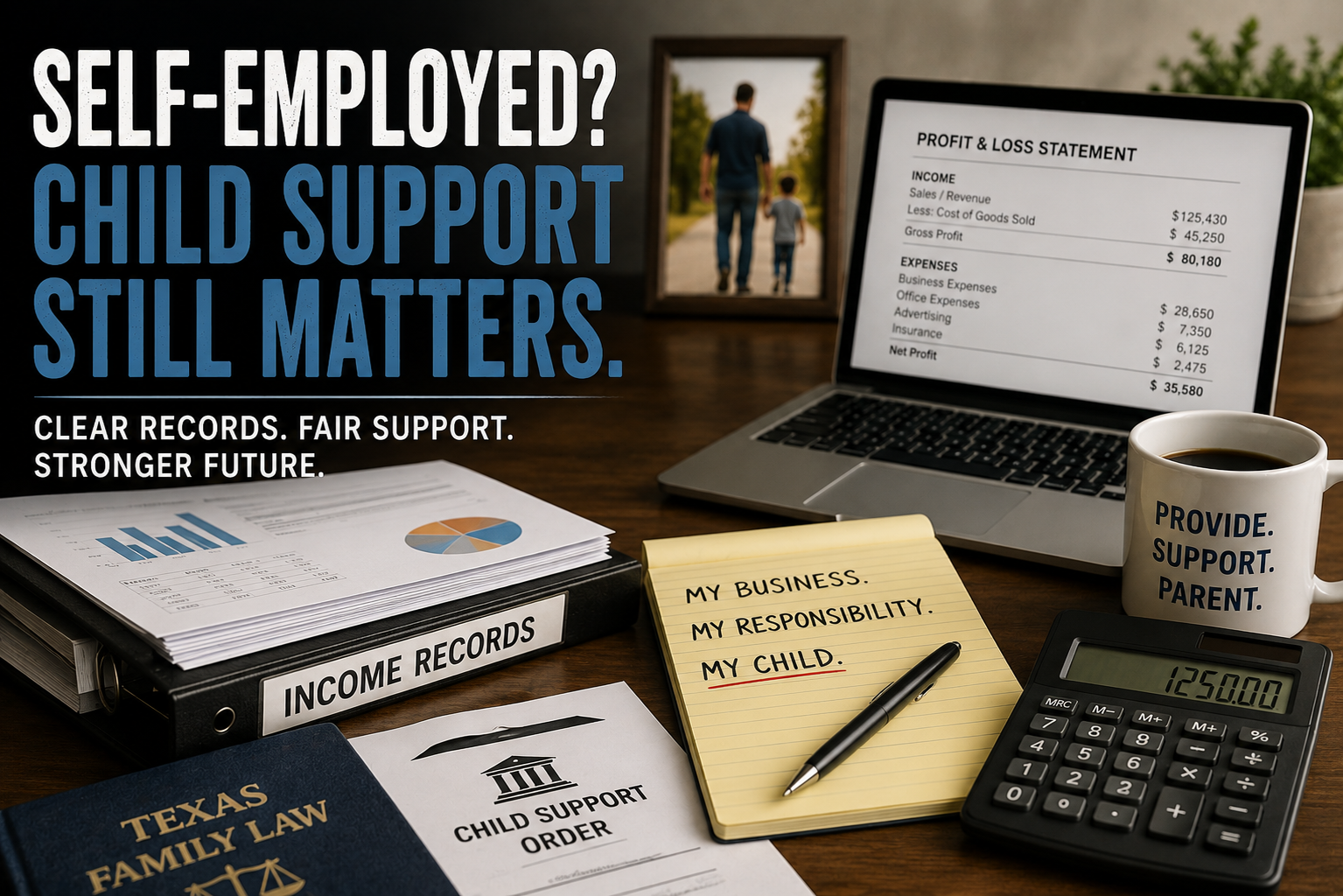
Child support usually becomes more complicated when one parent is self-employed because income does not always arrive in neat payroll cycles or show up on a single pay stub. A person may be paid by invoice, project, season, or client, and the business itself may have fluctuating expenses, delayed payments, and changing monthly totals. That can make the support discussion feel less clear even when the child’s needs remain the same. The challenge is not that support stops mattering. The challenge is proving income in a way the court can trust and use with confidence.
Why Records Matter Most
1. Earnings Are Harder to Track When Business Money and Personal Money Intersect
One major reason self-employment makes child support more difficult is that the parent’s earning picture is often spread across several documents instead of one employer-issued paycheck. A court or agency may need to review tax returns, income statements, balance sheets, 1099s, and other evidence of earnings to determine what the parent is actually earning. Texas court materials for family cases specifically require self-employed parties to provide profit-and-loss statements, balance sheets, income statements, or other evidence of earnings for the prior 12 months, along with federal tax returns and related records. That shows how strongly support decisions depend on documentation when regular wage records are missing. Self-employment does not remove the support obligation; it simply makes proof more document-heavy and more dependent on financial organization than a standard payroll situation would be.
2. Courts Need More Than One Snapshot to Understand Variable Income
A self-employed parent’s income may rise and fall in ways that make one strong month or one weak month misleading on its own. That is why support cases involving business owners or independent workers often depend on a broader financial picture rather than one recent payment. Texas court disclosure materials ask for more than one type of record and more than one time period, which reflects a practical reality: variable earnings are easier to understand when there is enough history to compare. In conversations around Texas Child Support, this is often where self-employment becomes harder to track, because the question is not only what came in recently but what the earnings pattern actually shows over time. A parent with invoices, deposits, and expenses moving in different directions may need to show a fuller record so the court can see past short-term fluctuations and focus on a more reliable income picture.
3. Revenue Alone Does Not Always Explain What Income Is Available for Support
Another difficulty in self-employment cases is that business activity can look larger from the outside than the money actually available to the parent at the end of the process. Gross receipts, incoming payments, and visible business volume may suggest one thing, while the actual funds available for living expenses and child support may look different once the business operation is examined more closely. That is one reason courts ask for more than just tax returns. Texas court materials requiring profit and loss statements, balance sheets, and income statements show that the legal process often needs a more complete financial picture before support is set. The issue is not simply whether money passed through the business. It is whether the records show a trustworthy measure of earnings that can support a fair order. When the documents are incomplete or confusing, the support calculation becomes harder because the court has less reliable information to work with.
4. Payment Logistics Change When No Employer Is Withholding the Money
Child support also operates differently in practice when the paying parent is self-employed, because there may be no regular employer to receive a wage withholding notice. Texas says wage withholding is how most child support is paid. Still, Texas court forms also state that if the obligor is self-employed or unemployed, the obligor may be ordered to send child support payments directly to the Texas Child Support Disbursement Unit. This matters because self-employment can affect not only how income is proven, but also how payments are collected and tracked after the order is entered. A regular paycheck creates one kind of enforcement path. Self-employment often requires more direct payment management, better recordkeeping, and closer attention to whether payments are made in full and on time. In that sense, the support order still works, but the mechanics of carrying it out may look different when there is no payroll department in the middle.
5. Changes in Self-Employment Income Usually Require a Formal Modification
Because self-employment can fluctuate, many parents assume support should automatically rise or fall with business income. In practice, that is not how the order works. In Texas, the Attorney General states clearly that the court-ordered amount can change only by court order, and TexasLawHelp explains that modification is tied to a change in circumstances or to a three-year review framework. This matters a great deal for self-employed parents because uneven income can create real pressure without changing the support amount on its own. If earnings fall, the order does not quietly adjust downward. If earnings rise, the receiving parent may still need to seek a formal modification to reflect that increase. That legal structure is important because self-employment often changes faster than court orders do. Good records, therefore, matter not only at the start of a case but also later, when a parent needs to show that the existing amount no longer reflects the financial reality.
6. Clear Financial Records Often Reduce Conflict and Delay
When self-employment makes earnings harder to track, the quality of the records can shape how long the case takes and how much conflict surrounds it. Federal child-support guidance from the U.S. Department of Health and Human Services emphasizes bringing financial and identifying information to the child support office, and Texas court materials show that self-employed parents may be expected to bring a fuller set of business and tax records than wage earners. Those expectations exist for a reason. The less clear the documents are, the easier it becomes for each side to argue over what the parent actually earns, what the business is doing, and whether support should be higher or lower. Clearer records do not make child support easy, but they often make it easier to understand. They give the court something concrete to work from and reduce the chance that the case will revolve around estimates, suspicion, or incomplete financial snapshots.
A Fairer Result Usually Starts With Better Documentation
Child support can still work when self-employment makes earnings harder to track, but it depends much more heavily on records than it does in a standard wage case. Tax returns, profit and loss statements, balance sheets, and other financial documents help the court move beyond guesses and toward a support amount tied to a fuller earnings picture. Self-employment does not erase the obligation to support a child. It simply makes proof, payment handling, and later modification more document-driven and more formal. When the records are organized and the process is handled through the court, the result is usually clearer, steadier, and easier to enforce over time.

About the Author
Fred Campos is a father, custody advocate, and host of the Daddy Got Custody podcast. He shares practical parenting and child custody tips to help parents navigate family court with confidence.
Join Our Newsletter

How Legal Services Protect Your Rights in Court
California residents navigating the court system often face complex legal challenges that can significantly impact their rights and future. Legal services play a critical role in protecting individuals throughout every stage of a case, from preparing evidence and...

When to Involve a Lawyer in a Divorce Case
Divorce is often one of life’s most challenging experiences, bringing emotional and financial upheaval. Knowing when to involve a lawyer can make the process less stressful and ensure decisions are made carefully. Many situations, such as disputes over finances, child...

What Types of Cases Does a Family Lawyer Handle?
In New Haven, Connecticut, family law encompasses a broad spectrum of legal matters that directly impact individuals and families. According to the Connecticut Judicial Branch, in 2024, the New Haven Judicial District reported 2,971 new family cases, highlighting the...

Tips for Dealing with a Struggling Marriage
Being married is something to be proud of, but also requires a lot of work. Not all days will be good, and you may go through tough situations together. Over time, there may be a strain on your marriage, and you may not be getting along as well as you did previously....

Tips To Create a Kid Friendly Wedding
Are you planning a wedding over the next few months? Are you considering remarrying with kids? This is a stressful time for anyone, let alone people who have small children in their families who are going to be attending the event. Of course, this adds a layer of...

Menstruation While Breastfeeding: What’s Normal and What to Expect
Menstruation while breastfeeding is different for every mom—it may return in months or take over a year. This article explains why it can be delayed, when it usually comes back, how it may affect milk supply, and the difference between spotting and a full...